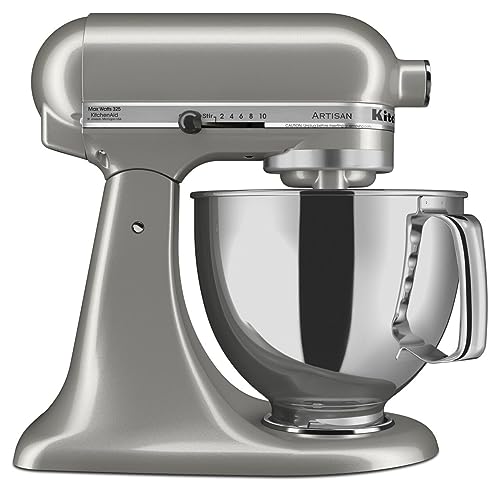
The KitchenAid Artisan 5-quart is the mixer most people picture when they hear “stand mixer.” It is a tilt-head design with a 5-quart bowl, a wide choice of colors and an attachment hub that turns it into a pasta maker, meat grinder or ice cream machine. This profile covers what reputable buying guides say about it, where it falls short and who it fits best. For all the options side by side, see our ranking of the best stand mixers of 2026.
We write from published sources, not our own measurements. We could not open KitchenAid’s product pages, so specs come from Bon Appétit’s stand mixer guide, which we credit by name, and we leave out any number we cannot trace to an opened source.
The Short Version
Bon Appétit calls the KitchenAid Artisan “a classic for a reason” and a long-standing favorite until the newer Artisan Plus beat it. In its testing, the Artisan performed nearly as well as the new model. It comes in a wider array of colors and, in Bon Appétit’s words, is a high-performing mixer that can accomplish any baking task. The trade-offs are modest: no precision speed control, no bowl light and no flex edge beater in the box.
That makes it a safe, well-rounded choice for most home bakers. It is not the strongest mixer for daily heavy dough, and it is not the most feature-rich. It is the one that fits most kitchens and most recipes.
Key Details According to Bon Appétit
- Style: Tilt-head. The top hinges back, and the bowl twists onto the base.
- Bowl: 5 quarts. Bon Appétit says 5 quarts is the size sweet spot, large enough for around nine dozen cookies in a batch, but not so large that smaller tasks are inconvenient.
- Speeds: 10 settings on the original Artisan, versus 11 plus a precision speed control mode on the Artisan Plus.
- Motor: Bon Appétit lists 350 watts for the Artisan Plus and says that is 25 watts stronger than the original Artisan.
- Attachment hub: Yes. KitchenAid’s attachments let the mixer act as a pasta maker, meat grinder or ice cream machine, according to Bon Appétit.
- Missing compared with the Plus: Precision speed control, a bowl light and a flex edge beater. Bon Appétit says you can buy a flex edge beater separately.
- Colors: A wider array than the Artisan Plus, which Bon Appétit says offers 14 color options.
Exact weight, dimensions and warranty for the original Artisan are not listed in the sources we opened, so we leave them out.
What a Tilt-Head Does Well
Bon Appétit describes the trade-off simply. With a tilt-head, the head hinges back and the bowl twists on, so adding ingredients is as easy as tilting the head. These mixers are usually more compact, which makes them better for smaller spaces and for storing in a cabinet, and they typically have less powerful motors.
That description fits the Artisan. Bon Appétit says the streamlined shape and tilt-head design of the Artisan Plus make it very easy to clean, and the Artisan shares that tilt-head layout.
Where It Falls Short
Three things come up in Bon Appétit’s comparison with the Artisan Plus.
First, no bowl light. On the Plus, a built-in light makes it easy to see inside the bowl even when your kitchen lighting is poor. The original does not have one.
Second, no precision speed control. The Plus adds a sliding-scale mode. The original sticks to its fixed settings.
Third, no flex edge beater included. That beater scrapes the bowl as it mixes. You can buy it separately, but it is an extra purchase, and without it you will scrape the bowl by hand more often.
On heavy dough, Bon Appétit says it has historically found the Breville Bakery Chef sturdier with dense doughs than most tilt-head KitchenAid models. Even the Artisan Plus’s head bobbed slightly while kneading challah. For one or two loaves, that is fine. For daily bread baking, a bowl-lift like the KitchenAid 7-quart bowl-lift is the more robust option.
Headroom Compared With the Mini
If you are weighing this model against KitchenAid’s smaller one, the main difference is headroom. Bon Appétit lists the Artisan Mini with a 3.5-quart bowl and a 250-watt motor, and says it kneaded a two-loaf batch of challah but likely could not handle a larger quantity. The 5-quart Artisan gives you a bigger bowl for double batches of cookie dough, so choose the Mini only when counter space is the deciding factor.
Who It Is For
Everyday home bakers. If you make cakes, cookies, frosting, whipped cream and the occasional loaf or batch of pizza dough, this is a comfortable fit. A 5-quart bowl handles most family recipes.
People who value color and looks. Bon Appétit highlights the iconic look and the wide palette. Bon Appétit compares the KitchenAid stand mixer to an Eames chair, an icon in its category.
People who want to grow into attachments. The hub means you can add a pasta roller or ice cream bowl later without buying a new machine.
Who Should Look Elsewhere
If you knead bread several times a week, a bowl-lift is a better match. The KitchenAid 7-quart bowl-lift and the KitchenAid Commercial 8-quart are the heavy-duty alternatives in our lineup, though both are much larger.
If counter space is tight, KitchenAid also makes the Artisan Mini, which Bon Appétit says is about two inches shorter and shallower than the full-size Artisan and five pounds lighter than the 5-quart model. The trade-off is that the Mini is less suited to a large batch of dough.
If you want the newest features, such as the bowl light and the half-speed setting, look at the Artisan Plus, which Bon Appétit and CNET both rank at the top of their lists.
Buying Tips
- Check the model. The Artisan and Artisan Plus look similar but differ in features, so confirm which one you are buying.
- Add a flex edge beater if you can. Bon Appétit says this is available as a separate purchase for the original model.
- Measure your cabinet. Even a tilt-head needs head room to open.
- Decide on attachments early. Bon Appétit says KitchenAid attachments are what make the mixer so versatile.
- Pick a color you like. You will see it every day.
The Bottom Line
The KitchenAid Artisan 5-quart is not the fanciest or the most powerful mixer here, but it is one of the easiest to recommend. It does nearly everything a home baker needs, it fits in most kitchens, and it comes in a wide range of colors. If you want a mixer for everyday baking and do not need to knead bread daily, this is a comfortable starting point.
Compare it with every other model in our stand mixer ranking.
Sources