We earn a commission if you buy through our links, at no extra cost to you.
Best Stand Mixer for Bread Dough (2026)
Bowl-lift or tilt-head, how much flour a bowl really holds, and which speeds to use for bread dough. Four stand mixers that fit home bakers who knead often.
At a glance
For heavy dough, a bowl-lift is the safer shape. The KitchenAid 7-Quart Bowl-Lift suits most home bakers, while the KitchenAid Commercial 8-Quart is for very large batches. The Bosch Universal Plus kneads with a bottom-drive hook, and the Hamilton Beach Professional 5-Quart is a lower-cost tilt-head for moderate batches.
Kneading is the hardest thing you ask a stand mixer to do. Cake batter and whipped cream are light work. A pound or two of bread dough is a heavy, resistant mass that pulls on the motor, the gears and the bowl clamp for several minutes at a time. That is why a mixer that is fine for cookies can wobble, walk across the counter or run hot when you switch to sourdough. This guide is for home bakers who make sandwich loaves, sourdough, pizza dough, bagels or cinnamon rolls often enough to care. It explains what to look for, then picks four mixers from our lineup that suit the job. For the whole lineup side by side, see our best stand mixers of 2026 ranking.
We do not run our own kitchen trials. Everything below comes from maker pages and published buying guides that we opened, and when a finding belongs to Bon Appétit or CNET, we say so by name.
Why Bread Dough Is Different
Bread dough fights back. Gluten forms as you knead, so the dough gets tighter and stickier as it develops, and the hook has to drag it around the bowl. Three things decide whether a mixer copes.
Stability. A light mixer can hop across the counter or rock on its base. Bon Appétit noted that a budget 5.3-quart tilt-head it included was able to knead hefty challah, but its small suction cups could not keep it from bouncing around the counter. Bon Appétit says heavy mixers have a place, particularly for dense bread doughs.
Reach. The hook has to touch the whole mass. Bon Appétit reported that the Cuisinart Precision Master’s dough hook struggled to reach the edges of the bowl and left floury bits in its challah dough. A good spiral hook and a bowl that is the right size for the batch matter as much as raw wattage.
Heat. Long kneading builds heat in the motor. Bon Appétit editor Jesse Szewczyk said a KitchenAid “tends to overheat when challenged with tougher doughs”, in a comparison with the Ooni Halo Pro spiral mixer. KitchenAid’s own spec sheet for its 8-quart commercial mixer highlights a DC motor designed to run longer with less heat buildup.
Bowl-Lift or Tilt-Head for Dough
Bon Appétit explains the split clearly. On a tilt-head mixer, the top hinges back and the bowl twists onto the base. That is convenient: you tilt the head to add flour or swap a tool. Tilt-heads are usually more compact and cheaper, with less powerful motors. On a bowl-lift mixer, the head stays fixed and a lever raises the bowl into position. Bowl-lifts usually have a larger capacity, a wider base and more power. Bon Appétit’s summary is blunt: they are the heavy-duty options, built to provide extra stability for large and heavy recipes, and if you will be kneading bread, this is the type for you.
CNET adds a practical point about tilt-heads: the height changes when the head is tilted back, so you may have to pull the mixer out from under overhead cabinets, and you need an extra inch or two of clearance. CNET lists most mixers at about 14 to 15 inches tall.
That does not rule out a tilt-head. Bon Appétit says the 5-quart KitchenAid Artisan Plus kneaded challah dough with no issue, although the head bobbed up and down slightly, and that the Mini kneaded a two-loaf batch of challah without trouble. If you bake one or two loaves a week, a tilt-head can do it. If you bake every other day, double batches or stiff doughs, go bowl-lift.
How Big a Batch Can You Make?
Most makers do not publish a flour limit, so treat any bowl size as a ceiling, not a target. The one hard number we found is on KitchenAid’s spec sheet for the Commercial 8-Quart: it says the bowl mixes recipes with up to 16 cups of flour, 13 dozen cookies or dough for 8 1/4 loaves of bread in a single bowl. That is a commercial figure for a commercial machine. For a home mixer, a good rule is to start well under the bowl’s capacity and watch how the mixer behaves. If the head bobs, the base creeps or the motor sound changes, split the batch.
Also remember that a bowl that is too big can work against you. Bon Appétit said the 7-quart KitchenAid was hard to use with small amounts of ingredients in such a large bowl, and that the Ooni spiral mixer struggled to fully work in pockets of flour in a batch of challah because of its very large bowl. Match the bowl to the loaf count you actually bake.
Speed, Time and Rest
Knead at low speed. Hamilton Beach says the slow first speed on its 4-quart mixer is great for kneading bread. Bon Appétit says the powerful Breville gave better results with bread dough at a lower setting than the “medium” many recipes suggest. The lesson is the same: a powerful motor on a high setting can be too much for the dough and too hard on the machine.
Beyond that, follow your owner’s manual. It sets the speed and the maximum run time for yeast dough on your exact model. If you do not have the manual, look it up under the model number on the maker’s support site. When a mixer feels hot or the sound changes, stop and let it rest, then finish the dough by hand if you need to. Bon Appétit reported that one budget model shut itself off after about 10 minutes of challah kneading, which is a good reminder that mixers are not designed to knead without limit.
Four Mixers for Bread Dough
We rank these by how well they suit regular bread baking in a home kitchen, using the makers’ own specs and the findings from Bon Appétit and CNET.
KitchenAid 7-Quart Bowl-Lift
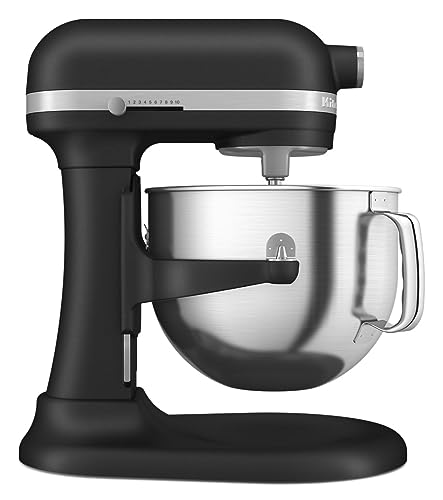
The practical bowl-lift for a home baker who kneads often: 7-quart bowl, 11 speeds and a double flex edge beater, with a more stable base than a tilt-head.
CNET names this its pick for a large stand mixer. According to CNET, it has a 7-quart bowl, a 500-watt motor, 11 speeds including a half-speed setting, and weighs 31 pounds, with a double flex edge beater, flat beater, dough hook, pastry beater, whisk and pouring shield in the box. It stands 16.5 inches tall. Bon Appétit says it did just as well in its testing as the model it recommends, and that the bowl-lift mechanism suits the larger capacity. The caveat is size: Bon Appétit found it bulkier and heavier than a 5-quart tilt-head and awkward for small amounts. If bread is your main use, that weight is a benefit. Read more in our KitchenAid 7-Quart Bowl-Lift profile.
KitchenAid Commercial 8-Quart
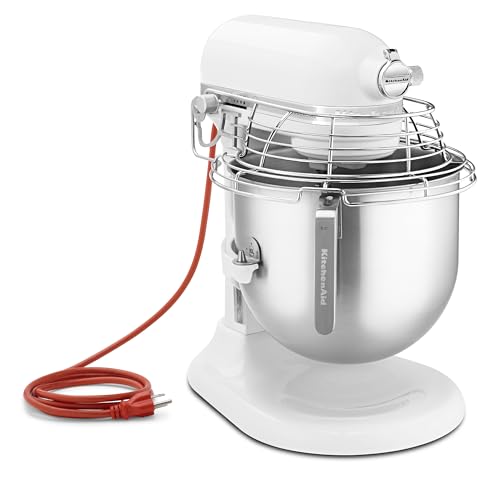
An 8-quart, NSF-certified commercial bowl-lift for bakers who make large or frequent batches. It is big and heavy, and more than most homes need.
According to KitchenAid Commercial’s spec sheet, the KSMC895 has an 8-quart bowl, a 1.3-horsepower DC motor (500 watts), an all-metal gear and housing design and a stainless steel bowl guard, and it is NSF certified for commercial use. The flat beater, 11-wire elliptical whisk and spiral dough hook are stainless steel and dishwasher safe, and the sheet puts the unit weight at 25.5 pounds without packaging. KitchenAid says the motor is designed for recipes needing longer mixing and kneading times. To be clear about the fit: this is a large, heavy machine, and it is overkill if you bake one loaf on weekends. If you regularly make double batches, it is one of two on this list with a published loaf count behind it; the Bosch is the other. See the KitchenAid Commercial 8-Quart profile.
Bosch Universal Plus
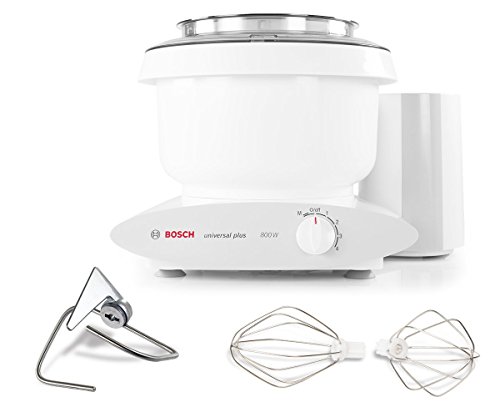
A different design: a 6.5-quart bowl with a bottom-drive shaft and a kneading hook, for bakers who accept an unusual layout.
The Bosch is not a classic stand mixer. Bon Appétit says it is essentially a motorized base with a 6.5-quart plastic bowl and a motor shaft up the middle, onto which you attach the whisk or dough arms. Bon Appétit called the machine confusing at first but said it performed well once the staff got the hang of it, with four speeds and a pulse function. Bosch’s US page for model MUM6N10UC lists 500 watts, a 4-stage control, a stainless steel and aluminum kneading hook, suction feet, and a weight of 12 pounds. NutriMill, Bosch’s US distributor, says it kneads up to 14 pounds of dough or 14 one-pound loaves, and that a dough hook extender keeps small batches, from a single loaf, evenly mixed. Those are the distributor’s figures, not ours. Details are in the Bosch Universal Plus profile.
Hamilton Beach Professional 5-Quart
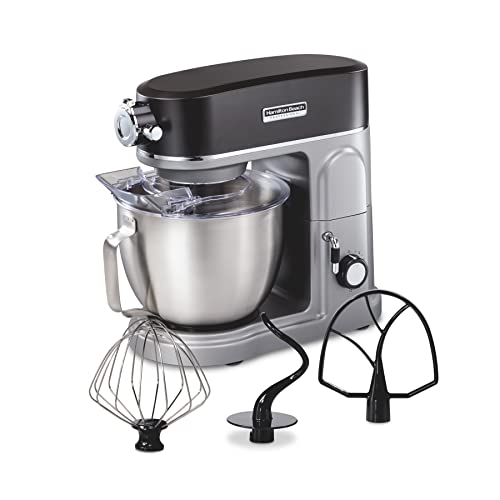
An all-metal 5-quart tilt-back mixer with a spiral dough hook and 12 speeds, for moderate batches of bread and pizza dough.
Hamilton Beach says this model has a 450-watt motor, 12 speeds, planetary mixing action, a 5-quart stainless steel bowl, a tilt-back head and a flat beater, whisk and spiral dough hook, with a 5-year limited warranty. Its page lists bread dough among the things it makes. We have no outside comparison of this model on dense dough, so treat it as a moderate-batch machine: good for a loaf or two, not for a double batch of stiff dough. It is also a tilt-head, so apply the stability advice above. Our Hamilton Beach Professional 5-Quart profile has the full picture.
Which One Should You Pick?
If you knead several times a week and have counter space, the KitchenAid 7-Quart Bowl-Lift is the balanced choice. If you cook for a crowd or run a small home bakery where loaf counts matter, the 8-quart Commercial is the one built for it. If you want a large dough capacity in a 12-pound machine with a different workflow, look at the Bosch. If you bake bread once or twice a week and want a tilt-head in a lower price band (see the $ badges), the Hamilton Beach Professional is the one to consider. Bakers who mostly make cakes and cookies are better served by a 5-quart tilt-head; see our KitchenAid Artisan 5-Quart profile for that route.
Small Habits That Protect the Mixer
- Add liquid first, then flour, so dry flour does not pack under the hook.
- Use the dough hook, not the flat beater, for yeast dough.
- Start at the lowest speed so flour does not fly, then move up only as far as the manual allows.
- Stop and check the dough every minute or two. If it climbs the hook, scrape it down.
- Stop kneading when the dough is smooth. Finishing by hand is fine.
- Keep the bowl clamp or lever fully engaged and the mixer on a clean, dry counter.
Sources
- Bon Appétit: The best stand mixers (2026)
- CNET: Best stand mixer of 2026
- KitchenAid Commercial KSMC895 spec sheet
- Bosch MUM6N10UC product page
- Bosch Universal Plus on NutriMill, Bosch’s US distributor
- Hamilton Beach Professional All-Metal Stand Mixer product page
- Hamilton Beach 4-Quart Stand Mixer product page
Frequently asked questions
Can a stand mixer knead bread dough?
Yes, as long as the batch fits the bowl and the motor. The dough hook does the kneading at low speed. Bon Appétit used a two-loaf batch of dense, sticky challah dough to judge mixers, and most of the models it recommends handled it, though some heads bobbed or the machine moved on the counter.
Is a bowl-lift better than a tilt-head for bread?
Bon Appétit says bowl-lift mixers are the heavy-duty option, with more powerful motors and extra stability for large, heavy recipes, and that if you knead bread often this is the type to pick. A tilt-head can still make a loaf or two, and Bon Appétit says the Artisan Plus kneaded challah with no issue, though its head bobbed slightly.
How much flour can these mixers handle?
Only KitchenAid's spec sheet for the Commercial 8-Quart gives a figure: up to 16 cups of flour, or dough for about 8 1/4 loaves in one bowl. Other makers do not publish a flour limit on the pages we opened, so check the manual for your model and start with smaller batches.
What speed should I use to knead dough?
Use the lowest speeds the manual recommends for kneading. Hamilton Beach says the slow first speed on its 4-quart mixer is good for kneading bread, and Bon Appétit found it got better results kneading on a lower setting than the medium that many recipes call for on a powerful mixer.
Can kneading damage the motor?
Heavy dough for a long time puts load on any motor. Bon Appétit reported that one budget tilt-head mixer got warm, changed sound and shut off after about 10 minutes of challah kneading, and one of its editors said a KitchenAid tends to overheat with tougher doughs. Keep kneading times short, keep batches within the manual's limit and let the mixer rest if the head feels hot.
Do I need a special mixer for sourdough or pizza dough?
Not necessarily for everyday batches. CNET says the Ankarsrum Assistent Original handles low-hydration doughs such as whole-wheat, rye, pizza and bagels, and Bon Appétit says the Ooni Halo Pro spiral mixer kneads lower-hydration doughs more easily than a KitchenAid. CNET also notes the Ankarsrum has lots of parts to store and is not beginner-friendly, so those machines suit dedicated bread bakers.