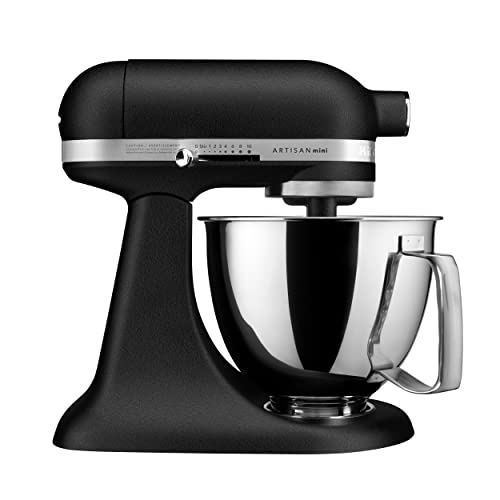
The KitchenAid Artisan Mini is a smaller version of the mixer that made KitchenAid famous. It has the same tilt-head design, the same look and a familiar accessory port, but a 3.5-quart bowl and a smaller motor. This profile explains what that trade-off means for a home baker. For the full ranking of eight mixers, see our best stand mixers of 2026.
We do not run our own kitchen trials. Specifications and findings here come from Bon Appétit, which put 14 stand mixers through batches of cake batter, challah dough and whipped cream. We attribute each finding to it by name. We could not open KitchenAid’s own product pages, so we rely on Bon Appétit’s spec box.
The Short Version
Bon Appétit named the Artisan Mini its pick for small spaces. According to its spec box, the mixer is a tilt-head model with a 3.5-quart stainless steel bowl, 10 speeds, a 250 W motor, a weight of 18 pounds and a one-year limited warranty. It comes with a mixing bowl, a coated flat beater, a dough hook and a whisk.
The magazine calls it a miniature version of the iconic KitchenAid Artisan that is “an absolute workhorse,” ideal if you bake small-to-medium batches of cakes and doughs or have limited counter and storage space.
Key Specs According to Bon Appétit
- Style: Tilt-head stand mixer.
- Bowl: 3.5-quart stainless steel.
- Speeds: 10.
- Motor power: 250 W.
- Dimensions: 12.3 inches deep, 7.8 inches wide and 12.3 inches high.
- Weight: 18 pounds.
- Included: Mixing bowl, coated flat beater blade, dough hook and whisk.
- Accessory port: Yes.
- Warranty: One-year limited.
Bon Appétit adds that the Mini is about two inches shorter and shallower than the full-size Artisan and five pounds lighter than the 5-quart model, which makes it easier to lift off the counter and store.
These figures come from Bon Appétit’s spec box. KitchenAid’s own product pages were not available to us.
What Bon Appétit Liked
Bon Appétit’s listed pros are an iconic look, attachment compatibility that makes it highly versatile, a smaller footprint than standard stand mixers and good handling of small batches.
On cake batter, the magazine says the small 3.5-quart bowl and an included flex edge beater ensured the butter and sugar were creamed until light and fluffy with virtually no manual bowl scraping. Its spec box, though, lists a coated flat beater, so the two parts of the article do not name the same beater.
On dough, the Mini kneaded a two-loaf batch of challah dough without issue, according to Bon Appétit. That is a respectable result for a compact machine, and it tells you something about what “small-to-medium batches” means: roughly two loaves, not four or five.
What Bon Appétit Did Not Like
The cons come from the same article. There is no built-in timer or lighting. No extra bowl or beater is included. There are not as many color options as a full-size KitchenAid.
Bon Appétit also says the Mini likely would not handle a larger quantity of challah dough than the two-loaf batch. Because of the slightly less powerful motor, it took a bit longer to whip a cup of cream to stiff peaks than the full-size model.
Finally, it notes the Mini is only a little cheaper than the 5-quart Artisan, so it is only really worth choosing over the other if space is a real concern. We do not quote prices, and they change, so check the current gap on Amazon.
Who It Is For
The Mini suits a kitchen where every inch of counter counts. If you live in an apartment, a dorm or a small house with limited cabinet space, a mixer that is two inches shorter and five pounds lighter is easier to live with. Bon Appétit says that makes it easier to lift off the counter and store.
It suits small households. If you bake a dozen cookies, a single cake or a small loaf at a time, a 3.5-quart bowl is enough, and Bon Appétit notes it handles small amounts of ingredients well. Bon Appétit says it found it difficult to mix small amounts of ingredients in the 7-quart KitchenAid’s large bowl.
It also suits bakers who want to own KitchenAid attachments. The accessory port means pasta rollers, grinders and other add-ons may fit, subject to KitchenAid’s compatibility information.
Who Should Skip It
Skip the Mini if you bake bread weekly or in volume. Bon Appétit says it probably cannot handle more than a two-loaf batch. A bigger machine such as the KitchenAid Artisan 5-Quart offers more capacity in the same family.
Skip it if you cook for a crowd. Holiday cookie batches, double cake recipes and multi-loaf bakes outgrow a 3.5-quart bowl quickly.
Skip it if you want a value pick and have space. Bon Appétit says the savings over the full-size Artisan are small, so the larger machine may give you more capacity for a similar outlay.
Skip it if you want the cheapest possible mixer. The Hamilton Beach 4-Quart is an entry-level alternative, though Bon Appétit found the bowl of a Hamilton Beach 4-quart mixer it tried too small.
The Mini vs. the Full-Size Artisan
The comparison is the heart of this decision, and Bon Appétit frames it clearly. The Mini is the same design in a smaller package. The magazine’s full-size pick, the Artisan Plus 5-quart, was its overall winner, while the Mini was named best for small spaces.
What you gain with the Mini: about two inches less height and depth, five pounds less weight and better handling of small quantities. What you give up: bowl capacity, motor power and a longer time to whip cream. If you lack space, the Mini is a smart choice. If you merely like the idea of “smaller,” the larger model gives you more headroom.
How It Fits Our Lineup
In our ranking, the Mini is the compact pick. It is a mid-tier choice in features and a small-batch machine by design. Its nearest neighbors in the ranking are the Bosch Universal Plus, a very large mixer with an unusual design, and the Cuisinart Precision Master, a 5.5-quart tilt-head with 12 speeds.
Together they show the spread in this category: a compact 3.5-quart machine, a mainstream tilt-head and an unconventional bottom-drive mixer. Each fits a different kitchen, and our comparison lays them out side by side.
Using It Day to Day
A tilt-head mixer is easy to learn. You tilt the head back, lock in the bowl, attach a beater, lower the head and start on a low speed. Tilt-head designs are the most common for home bakers because you can reach the bowl easily to add ingredients.
With 10 speeds on a 250 W motor, begin at the lowest speed with dry ingredients to avoid a flour cloud and move up as the mixture comes together. For doughs, work in smaller quantities than you would in a full-size mixer and keep an eye on the motor. If the head feels warm or the sound changes, stop and let it rest. Bon Appétit reported such overheating on a different mixer, not the Mini, but it is a good habit with any compact motor.
Care and Storage
The Mini is 18 pounds, according to Bon Appétit, so it is manageable for many people to move between counter and cabinet. Wipe the base with a damp cloth. For the bowl and attachments, follow KitchenAid’s care instructions, which we could not open, so check your manual for dishwasher guidance.
Bottom Line
The KitchenAid Artisan Mini is a small, familiar mixer for small kitchens and small batches. According to Bon Appétit it creams, kneads a two-loaf challah batch and whips cream well enough, with limits on capacity and speed. Pick it when counter space is the deciding factor, and consider the larger Artisan when it is not. See where it lands in our best stand mixers of 2026.
See price on Amazon
Sources